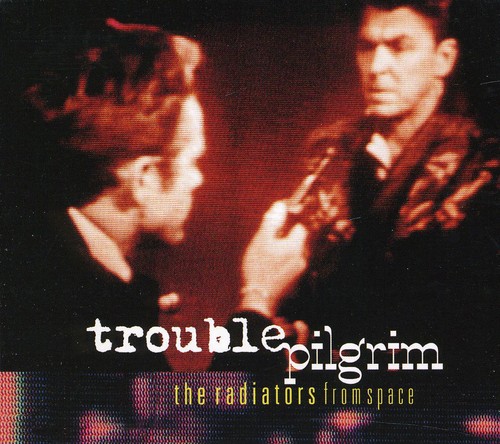
The Radiators From Space are a legendary Irish band, originally formed in 1976 in Dublin and consisting of Philip Chevron (who was later to perform with the Pogues), Pete Holidai, Steve Rapid, Jimmy Crashe and Mark Megaray. They signed to Chiswick Records in 1977 and released two albums, 'TV Tube Heart' in 1977 and 'Ghostown' in 1979. The latter received critical acclaim, but failed to sell well and the band disbanded in 1981. Radiators songs have been recorded by Christy Moore ('Faithful Departed') and Mary Coughlan ('Kitty Rickets'). The band reunited in 2004, with a slightly different lineup (Crashe and Megaray left the band and were replaced by Cait O'Riordan and Johnny Bonnie) and the shortened name The Radiators. 'Trouble Pilgrim' is the band's third album and first in 25 years. THE RADIATORS FROM SPACE Trouble Pilgrim. Not a classic reissue this time, but a BRAND NEW STUDIO ALBUM from a genuine touchstone of Irish music! Who's there? The year was young and I had just done hibernatin' / I woke up in a fifty dollar bed in the Bexar County Jail / Oh! Oh! Had me a hankerin' for Heaven / or, failing that, some handsome stranger / Oh! Oh! This time I'm bustin' loose /and grasping the nettle of danger. ('Trouble Pilgrim', Trouble Pilgrim) And so it is, kicked off by the jagged mirror-image Telecasters of Philip Chevron (songs, vocals, right-handed guitars. Day job: him out of The Pogues) and Pete Holidai (songs, vocals, left-handed guitars. Day job: music teacher, record producer), our questing anti-heroes The Radiators from Space embark on another mission to.......where? Well, if they knew that, what would be the point in going there to find out? They only know that this time their original guiding force Steve Rapid (voices, vintage synths, percussion. Day job: rock 'n' roll design and real country music) is back on board, taking them once again au pont. They only know that driving the engine this time are Hibernia's own JBs - the stupenduous team of Jesse Booth (bass) and Johnny Bonnie (drums). They only know that this latest journey began at a low-key show in December 2003 in tribute to fallen comrade Joe Strummer and that since then they have made many stops along the way, from an intimate Ace Records 30th Birthday shindig in Dingwalls, London in 2004 to Dublin's Croke Park Stadium in 2005, opening for long-term superfans U2. Hey Joe, a-rovin' we will go / all the way from Cuba to Fallujah, they're all eating Freedom fries / Hey Joe, I miss you more than you could know / it's not a world you'd recognise / and it still takes me by surprise / And now the U. N. is on the phone / America is going it alone again / and it's a bad day for Democracy, which needs a sweeter tone / It is a bad day for Democracy / the World is in the danger zone / And that's when I remember the summer I spent with Joe Strummer.......... ('Joe Strummer', Trouble Pilgrim) They've been around a wee bit, these Radiators. In 1977, Kassel University booked them to headline a Festival celebrating 200 years as an illustrious Art Academy. 'Aus den Ruinen von Belfast........kommen die RADIATORS FROM SPACE (Dublin, Ireland)' If the star billing erred a little on the side of hyperbole, there were many who at least seemed willing to agree with the Prof. Provost when he later emotionally informed the German media, his students and anyone else who'd listen that 'The Radiators have changed my way of thinking about life'. So, what way of thinking would that be then? To begin, the Radiators (from, yes, Dublin) found much common cause with the energy and passion of their fellow young bands over in London, but they also soon found the preoccupations somewhat adrift from their own. Boredom? If the Kids Are United? The Right to Work? Anarchy? Rock Against Racism? They were little more than modish slogans to kids who'd grown up in Ireland in the 60s and 70s. Modern Irish culture, almost in it's entirety, could be said to have presented itself, portrayed itself from all angles, had itself debated and, where necessary, swept itself under the carpet, all on the medium of Irish Television in that period. By the time there was a national TV service (RTE in 1961) it was the only channel two-thirds of the country could actually receive and so, with it's diet of classy- trashy American imports and carefully vetted British shows and Polish cartoons, it cast an uncertain light on the still nascent Irish Republic. But also, thanks to a clutch of home-grown media revolutionaries it became, in time, a forum more powerful than the Church Pulpit itself. The Radiators considered themselves uniquely to be of the only baby boom subset to have known a world before and after the sudden intervention of television in their lives. So it was that for their early work, from their first 45 'Television Screen' - shorter than a commercial break - to their more charged-up debut album TV Tube Heart (September 1977), they made this their principal subject matter. But that was then. 'Welcome!' Steve Rapid is about to perform his first lead vocal on a Radiators record in almost three decades. For this album, he will act as a sort of tour-guide, a Chorus on the progress of these lovelorn, despairing and ever-circling Pilgrims without hope, without Exodus, without prospect of milk let alone honey; a Chaucer to bring the wildest fantasies to new lows of depravity even as he reappears in the white noise and luridly remorseful disguise of a contrite radio talk show host imploring his flock to be prepared for the End Times. 'Steve, what's the first thing you're going to say to the eager listeners?' asks the left-handed guitarist over the intercom between control room and studio, as he sets up for a take. 'Welcome!' 'Quite a polite Concierge then.' remarks the right-handed guitarist. 'Well, it has been 30 years.' Welcome! I am the Concierge of the knocking shop in Babylon / If you should feel the urge / This is the hottest spot since old Saigon / Nancy boys and dancing girls, strictly for your pleasure / Here the profits (peace be upon them) / are measured in blood and treasure. ('The Concierge', Trouble Pilgrim) Love and Peace. War and Sex. Sex and war. Love not War. Sex not Love. Sex as one of the oldest commodities of warfare. So what's to do if your war zone is also potentially the deadliest place on Earth in which to have unmediated sex? What happens if you are offered not so much a post-coital cigarette as a mandatory stoning to death? Well, here we make our own entertainment, essentially. All sides in a conflict will have some sort of fixer who gets round the technicalities for a price and, real neighbourly like, helps keep the incidence of Rape hovering only just above the the line of the Amnesty radar. But this remains a Babylon sans frontieres. The dizzy line between instruments of genital torture and weapons of mass destruction, when one entity exists and the other does not, gets a bit blurred in this climate. Are we hearing yelps of masochistic pleasure or listening to agonised death throes? Has this Concierge taken us to the best kip in town or to Abu Ghraib Correctional Facility? Fatima-Jenny (voiced by Anita Bonnie) picks up the Anglo-Saxon-Latin slang fast and is recycling it for her own linguistic pleasure. With so much to lose, what's to lose? Semper Fi, buddy / Always true / Semper Fi, buddy / Semper F*** you! Not for the first time, the Radiators set a key song in a sort of brothel. In their Ghostown album, we met James Joyce's Becky Cooper - he fictionalised her as 'Kitty Ricketts' in Ulysses - as both a conduit for Irish Church / State hypocrisy and in celebration of the once-Pagan Irish themselves. Where there is a brothel, the Rads have noticed, there is a culture of dissoluteness, corruption and criminal activity closely adjacent. Adjacent, see. Not in the brothel, close to the brothel. They are good observation posts for the undercurrents of the world. No accident that Monto, Dublin's red-light area until the